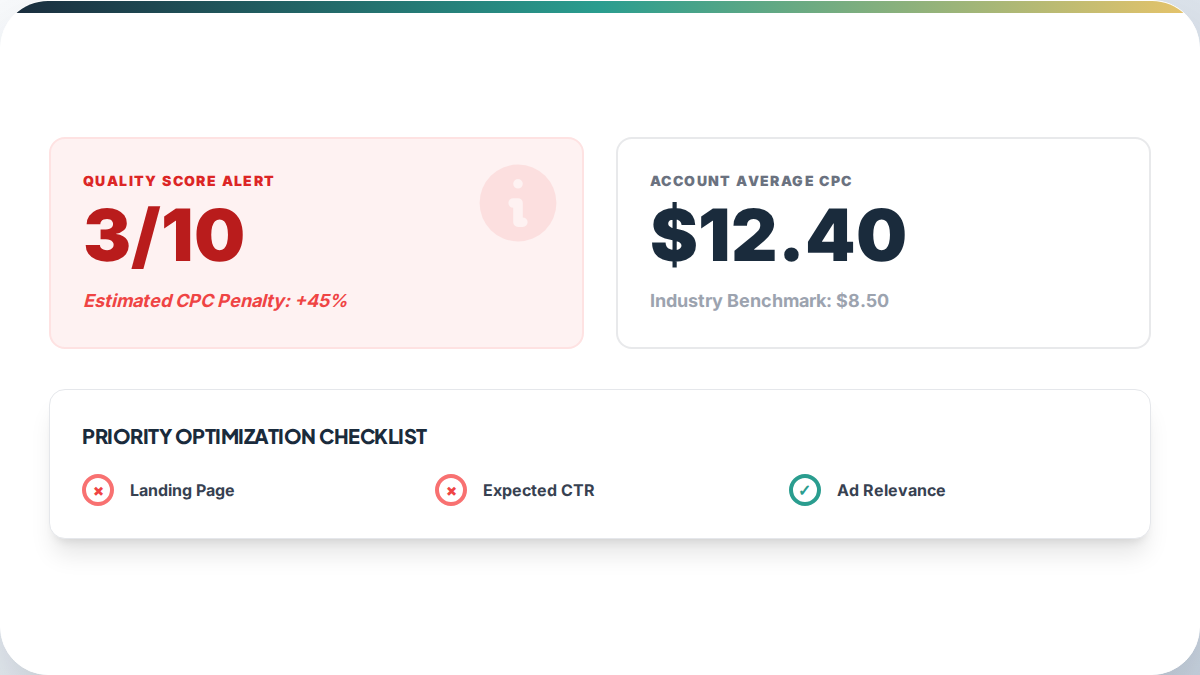
Your cost per click is rising because more advertisers are competing for the same signals. When every business in your category bids on the same keywords and the same audience segments, auction prices go up. The answer isn't to outspend your competitors - it's to find the customers they're missing by targeting behavior and intent, not just the obvious search terms.
Why CPC Keeps Rising Year Over Year
Cost per click tends to rise in competitive markets for a predictable reason: ad platforms get better at identifying likely buyers, and every advertiser concentrates their budget on those same likely buyers. The more competitors bid on a narrow audience, the higher the clearing price.
This creates what you might call the efficiency trap. The more obvious the signal - someone searching for "best CRM software" - the more competition for that click, and the higher the price. Businesses that rely entirely on high-intent keyword targeting end up in an arms race that favors whoever has the largest budget. Beyond targeting, the technical setup behind your ads - conversion tracking, Quality Score, landing page experience - has a direct effect on what you pay.
The Role of Smart Targeting in Lowering Costs
The alternative to bidding on obvious signals is to target behavior - what someone is doing, not just what they're searching. Ad platforms have access to a wide range of behavioral signals beyond search terms: the types of content someone reads, how they move between devices, how long they spend on category-related pages, and what kinds of offers they've responded to in the past.
Using these signals to identify high-intent users before they reach the competitive search auction means you're often reaching them in a lower-cost placement - display, discovery, or video - while their intent is just as high. HatcherSoft recommends auditing your current campaign targeting to see what percentage of your spend is concentrated on the highest-competition keywords, and whether behavioral signals could reach the same audience at lower cost.
Not All Clicks Are Worth the Same Price
One of the most common reasons ad spend becomes inefficient is bidding the same way for all potential customers, regardless of their actual value to the business. A first-time buyer with a small initial purchase is worth less than a repeat buyer who tends to purchase a large package.
If your bidding strategy doesn't account for the long-term value of a customer, you'll consistently win auctions for the wrong customers and lose auctions for the right ones. Adjusting your bids based on customer value signals - not just conversion probability - tends to improve the quality of traffic even before the total volume changes.
Identifying Under-Targeted Segments
Every competitive market has profitable audience segments that aren't being targeted aggressively. Finding them requires looking at your existing customer base for patterns that aren't obvious from the standard demographic and keyword data:
- Which customers closed fastest?
- Which customers had the highest lifetime value?
- Which customers referred others?
- What did those customers have in common that isn't captured in your current targeting?
These patterns become the basis for new audience segments. Because they're less obvious, they tend to have less competition and lower CPCs than your primary keyword targets.
A Practical Approach to Reducing CPC
- Audit where your spend is going. Break down your CPC by campaign, ad group, and keyword. Identify which segments have the highest cost and lowest return.
- Separate brand from non-brand spend. Brand searches are almost always cheaper and higher-converting. If brand and non-brand are mixed together, your aggregate CPC obscures the real cost of non-brand traffic.
- Test behavioral targeting against keyword targeting. Run a controlled test where a portion of your budget goes to behavioral audience targeting rather than pure keyword bidding. Local targeting is one of the most underused levers for service businesses. Measure conversion rate and cost per conversion, not just CPC.
- Review your match types. Broad match keywords often drive irrelevant clicks at high volume. Tightening match types reduces wasted spend even if it reduces total impressions.
- Adjust bids by customer value, not just conversion rate. If your CRM data shows that certain segments produce higher lifetime value, bid more aggressively for those segments even if the initial conversion probability is similar.
The Bigger Picture
Rising CPCs are partly a market condition you can't control. But a meaningful portion of ad inefficiency comes from targeting and bidding practices that can be changed. The businesses that manage their ad costs most effectively tend to be the ones that invest in understanding their customer data, not just the ones with the largest budgets. Your landing page quality matters too - a page that converts well makes every click worth more, regardless of what you paid for it.
If your ads are profitable at current CPCs, the goal is to protect that margin as costs rise. If they're not yet profitable, the priority is finding the targeting approach that gets you to profitability before scaling spend. Our Google Ads management service can help you find that approach.