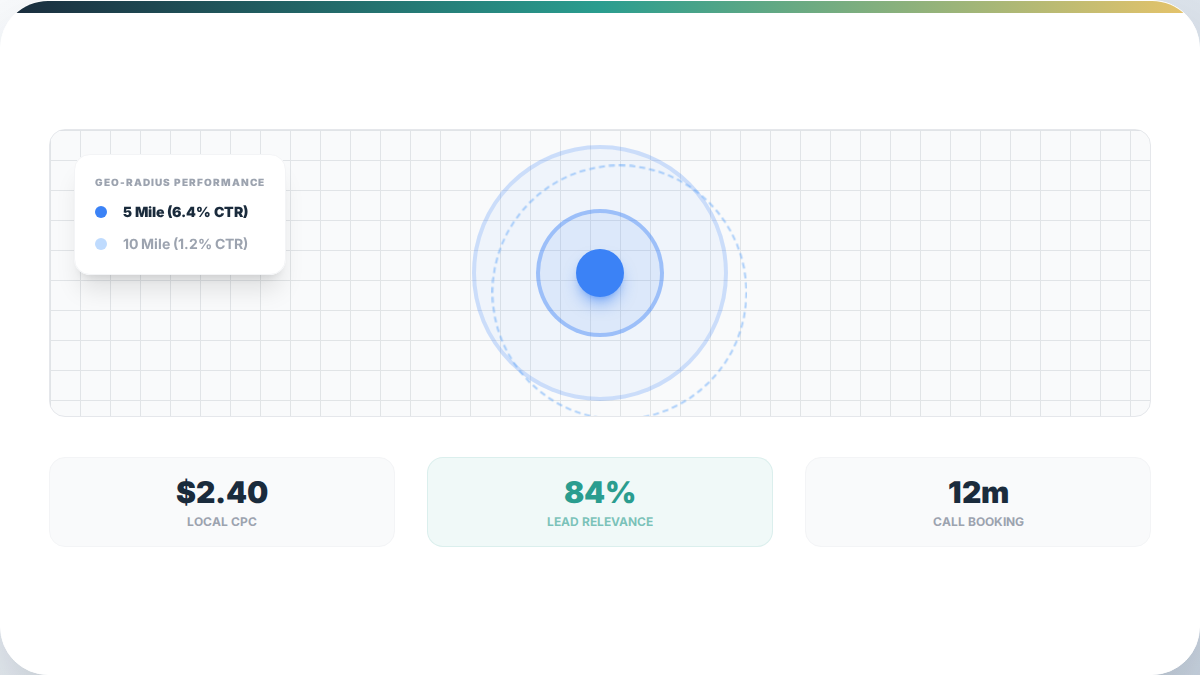
Most service businesses waste a significant portion of their ad budget by targeting too broadly. Setting a 10-mile radius and running the same ad to everyone in it is the default - but it's rarely the most profitable approach. Tighter geographic targeting, adjusted to reflect where actual demand is coming from, typically reduces cost per lead while improving the quality of the jobs that come in.
The Problem With Radius Bidding
Radius bidding is the practice of drawing a circle around your business address and showing ads to everyone inside it. It's simple to set up and feels comprehensive. But it has a few consistent problems:
- It includes areas where demand for your service is low
- It includes areas where your strongest competitors already dominate
- It treats a neighborhood with high-value clients the same as one where the average job is half the price
- It ignores time - a neighborhood might have high demand on Tuesday afternoons but not on Saturday mornings
None of these factors show up when you set a radius and move on. They only become visible when you look at where your best jobs have actually come from.
Starting With Your Own Data
The most valuable input for local ad targeting is your own job history. If you can map the jobs you've completed over the past 12 months by zip code or neighborhood, you'll typically find that a small number of areas account for a disproportionate share of your revenue.
HatcherSoft recommends running this analysis before making any changes to targeting. The technical foundation behind your campaign - conversion tracking, match types, landing page setup - should be solid before you refine your geographic approach. Look for:
- Which zip codes or neighborhoods produced the most jobs?
- Which areas had the highest average job value?
- Which areas led to repeat customers?
- Which areas were profitable after accounting for drive time?
This analysis often reveals that the 20 percent of your service area generating 80 percent of your revenue is much smaller than your current radius. Concentrating budget there reduces waste immediately - and if you've been noticing rising costs across your campaigns, spreading your budget too thin across a wide radius is often part of the reason.
Demand Signals Beyond Geography
Geography tells you where your customers are, but it doesn't tell you when they're ready to buy. For service businesses, timing often matters as much as location. Some examples:
- HVAC companies see demand spike after the first hot day of summer
- Roofers see spikes after local storm events
- Landscaping businesses see surges in spring around the same time each year in specific neighborhoods
- Plumbing services get emergency calls clustered in certain areas during cold snaps
Matching your ad spend to these timing patterns - rather than running at a constant level all year - improves both cost efficiency and conversion rate. The budget is there when demand is highest and conserved when it's not.
Neighborhood-Specific Messaging
Generic ad copy performs worse than specific ad copy. When someone in a particular neighborhood sees an ad that mentions their area by name, references a local landmark, or speaks to the specific type of home or property common there, they pay more attention.
This doesn't require a separate campaign for every neighborhood. Platforms like Google Ads and Meta Ads support location insertion and audience segmentation that allows you to show slightly different ads to different geographic segments without building everything from scratch. A few variations, tested against each other, often outperform a single generic ad by a meaningful margin.
Clustering Jobs to Reduce Drive Time
For businesses where drive time is a real cost - field service companies, HVAC, plumbing, cleaning services - job clustering is an underused efficiency lever. When your team is working in a specific area, increasing ad spend in that same area for the same day means you can complete multiple jobs without long drives between them.
The math works clearly: if a technician can complete three jobs in a tightly clustered neighborhood rather than two jobs spread across a 15-mile range, the third job is nearly pure margin. The ad spend to generate that third job in the right area is well worth the cost.
A Practical 90-Day Plan
- Days 1-30: Map your past 12 months of jobs by location. Identify your highest-revenue zip codes and neighborhoods. Set up location bid adjustments to increase spend in those areas.
- Days 31-60: Create two or three location-specific ad variations for your top areas. Test them against your current generic ad. Track cost per lead and lead quality separately by neighborhood.
- Days 61-90: Analyze the results. Shift budget toward the areas and times that produced the best ROI. Begin adjusting daily or weekly based on your team's job location to increase clustering efficiency.
The Bottom Line
Hyper-local advertising isn't about more complexity - it's about better alignment between where you spend and where the business actually comes from. Most service businesses that run this analysis find that they can get the same or better results by concentrating budget on a smaller, more profitable area instead of spreading it thin across the whole radius. Of course, none of this matters if the page people land on isn't doing its job - a website built to convert makes every targeted click worth more. Our Google Ads management service covers both the targeting strategy and the landing page side of the equation.