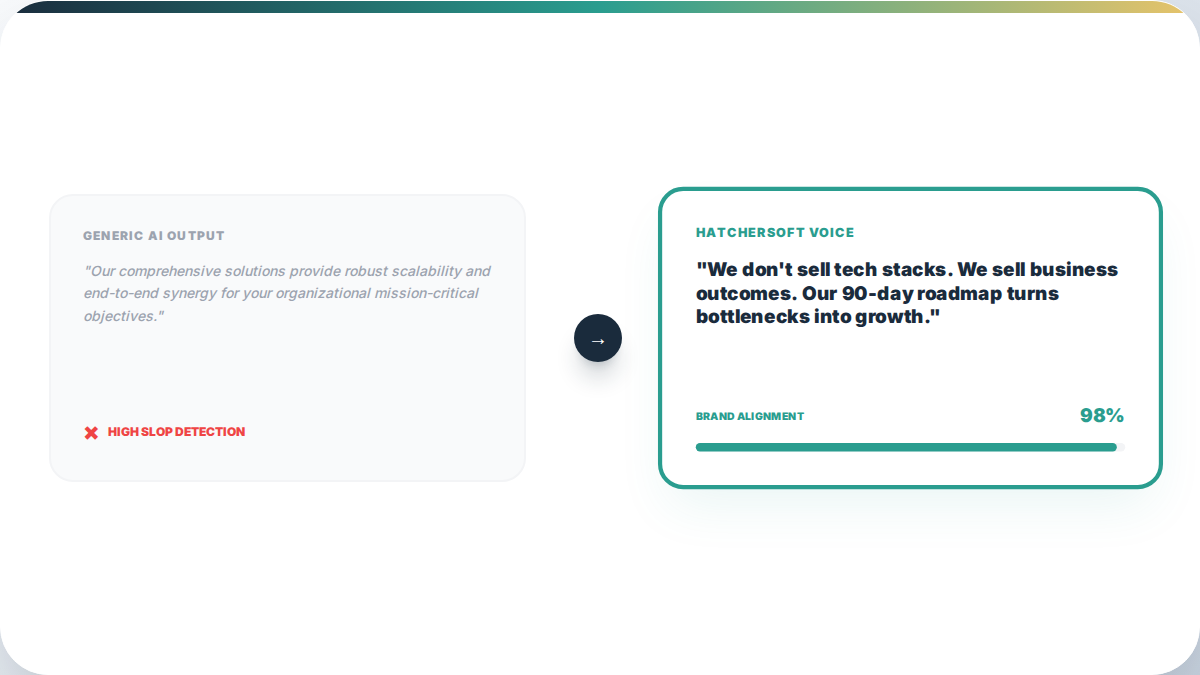
Brand voice matters more now because it's harder to stand out. When anyone can generate polished, professional-sounding text in seconds, the businesses that communicate with a genuine, recognizable voice are the ones people actually remember. A consistent voice isn't just a marketing preference - it's a practical differentiator when your competitors are producing the same kind of generic content at scale.
The Generic Content Problem
The explosion of content generation tools has produced a recognizable problem: the internet is filling with text that is technically correct, professionally formatted, and entirely forgettable. The same phrases appear everywhere. The same structure. The same transitions. It reads as though it was written by someone whose main goal was to avoid saying anything wrong, rather than to actually say something.
This creates an opening for businesses willing to communicate differently. A company that writes with a specific perspective, uses its own language, and shares its actual views on its field will stand out - not because they're louder, but because they're distinct. Distinction is increasingly rare.
What Brand Voice Actually Is
Brand voice is the consistent personality that comes through across your communications - your website, emails, social posts, proposals, and client conversations. It's not just tone (formal vs. casual) - it's the full picture of how your business expresses itself.
Businesses with a clear brand voice share a few characteristics:
- They have a consistent point of view on their field, not just descriptions of what they do
- Their writing sounds like a specific person (or team), not a generic corporate entity
- The same voice comes through whether they're writing a blog post, a proposal, or a quick email response
- Their language choices are deliberate - they've made decisions about what words they use and don't use
Why Brand Voice Affects AI Search Citations
AI search tools aren't just looking for the most comprehensive answer to a question - they're looking for authoritative sources. Authority signals include being cited by other credible sources, having consistent content across a domain, and demonstrating a clear, specific perspective on a topic rather than covering everything at surface level.
Businesses with a distinctive voice tend to produce content that's more citable. A piece that makes a clear argument and backs it with specific evidence is more useful to an AI tool trying to answer a complex question than a piece that hedges every statement and presents all sides without taking a position. Distinct voice and intellectual specificity often go together. If showing up in AI search is part of your growth strategy, a recognizable voice is one of the things that makes your content worth citing over a generic alternative.
Maintaining Voice When Using Writing Tools
The practical challenge is that teams use writing tools to produce content faster, and those tools default to a generic output unless given specific direction. A few approaches that work:
- Build a voice reference document. Collect examples of your best writing - emails, blog posts, proposals - and annotate what makes them sound like you. This becomes the reference for anyone on your team producing content, and for any tools you use to assist.
- Define what you don't say. A list of banned phrases, avoided structures, and off-brand tones is often more useful than a list of what to include. If your business never uses corporate buzzwords, say that explicitly.
- Use tools for drafting, not publishing. The output of writing tools is a starting point. Editing it to match your voice takes significantly less time than writing from scratch but produces better results than publishing unedited.
- Review cross-channel consistency. Your website, your email sequences, your social media, and your sales proposals should all feel like they come from the same place. Inconsistency breaks the effect of having a voice at all.
The Trust Connection
There's a practical reason that a consistent, genuine voice builds trust: it signals stability and reliability. A business whose communications sound the same across time and channels is communicating that it has a real identity - that there are actual people with actual views behind the content. This matters more as AI-generated content becomes ubiquitous and harder to distinguish from human writing by surface characteristics alone.
High-ticket clients especially - the ones considering a meaningful investment in a service - tend to read carefully before committing. If your content sounds like everything else they've read, there's no reason to remember you. If it sounds like people who actually know what they're talking about and have something to say, that creates a different kind of impression. That trust translates directly to conversions - which matters especially when you're working to turn AI-referred visitors into booked calls.
A Practical Starting Point
- Audit your recent communications. Read five to ten pieces of your own content back to back. Does it sound consistent? Does it sound like you? If not, identify specifically what's different between the ones that do and the ones that don't.
- Build a short voice guide. Two to three pages is enough. Include examples of good and bad, a short list of your characteristic phrases and approaches, and your position on key topics in your field.
- Apply it to one channel first. Pick your website or your email newsletters and rewrite them to match the guide. Use that as the reference standard before rolling it out elsewhere.