To audit your website for AI crawlability, you need to check whether AI search tools can read your content accurately and completely. The key factors are load speed, structured data quality, HTML clarity, and how your brand appears across external sources. A site that passes a traditional SEO audit may still have significant gaps for AI indexing.
Why AI Crawlability Is Different From Traditional SEO
Traditional SEO audits look for keyword relevance, backlink profiles, and meta tag optimization. AI crawlability audits look for something different: whether an AI tool can accurately extract and summarize what your business does. Understanding why AI visibility matters for your business is a useful starting point before diving into the technical audit.
AI tools don't browse your site the way a human does. They ingest the raw content - the text, the structure, the schema data - and try to form an accurate model of your business. If that content is ambiguous, hidden behind JavaScript, or inconsistent across pages, the AI's representation of your business will be incomplete or wrong.
The Three Pillars of an AI Crawlability Audit
1. Load speed and technical performance
AI tools have limited time to spend on each page. A slow site may be crawled incompletely, or not at all if the tool determines the page isn't worth the wait. The threshold that matters most is time to first byte (TTFB) - the time it takes for the server to begin responding to a request. The full picture of how page speed affects AI indexing is worth understanding before you run your audit.
Target benchmarks for AI crawlability:
- TTFB under 200ms
- Full page load under 1 second
- No render-blocking resources that prevent the main content from appearing
- Core content available in the initial HTML, not loaded by JavaScript after the fact
2. Structured data and semantic accuracy
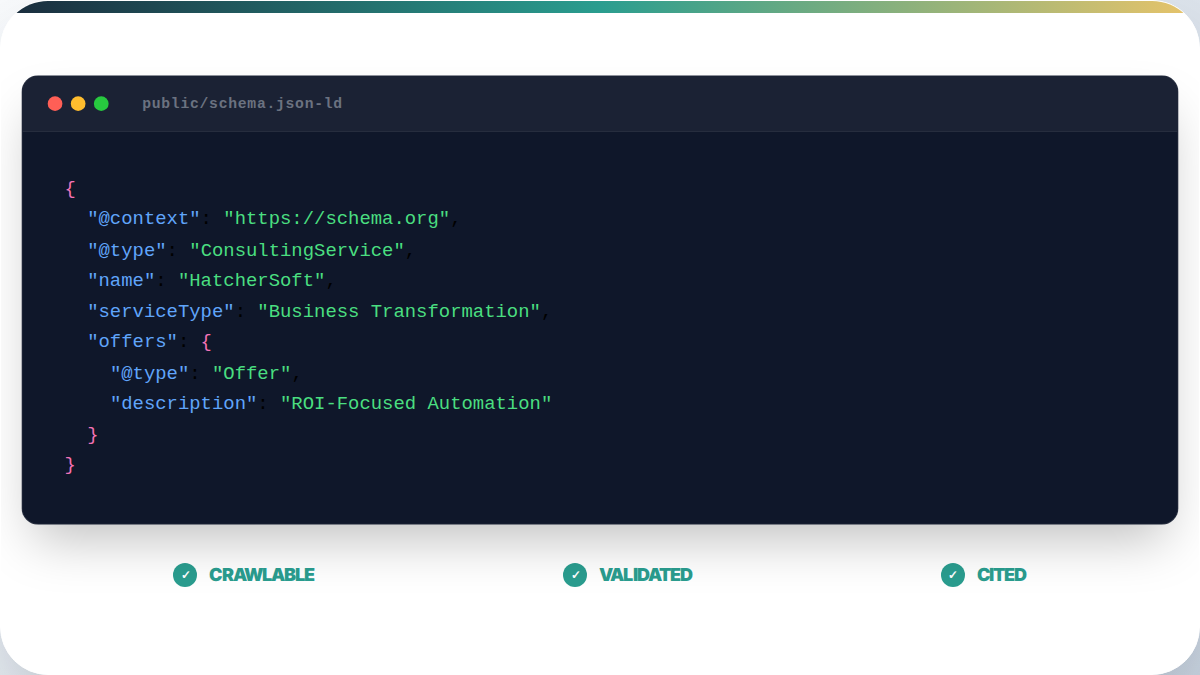
Structured data (JSON-LD schema) tells AI tools what your content means. Without it, the tool has to infer what your business is and does from the text alone - which introduces the possibility of misrepresentation.
For a service business, structured data should accurately describe:
- The organization: name, address, phone, email, and what the business does
- The services offered: specific descriptions that match how clients search for them
- Any content like articles or guides: author, date, and topic clearly labeled
- Reviews and ratings: if present, in a format AI tools can read and cite
HatcherSoft recommends testing your schema using Google's Rich Results Test and manually querying AI tools with questions about your business to see what they return. Discrepancies between what you say and what AI tools report often trace back to missing or inaccurate schema.
3. Content clarity and HTML semantics
AI tools read the DOM - the actual structure of your HTML. If your most important content is buried inside deeply nested components, loaded by JavaScript after the initial render, or presented in a way that separates visible text from the underlying code, AI tools may not find it.
Check that your pages meet these standards:
- The most important content appears in the raw HTML, not only after JavaScript execution
- Headings (h1, h2, h3) accurately reflect the structure of the content
- Text is in actual HTML text elements, not images of text or canvas rendering
- Navigation and main content are clearly separated in the HTML structure
External Citation Presence
A site audit looks at your own website, but AI crawlability also depends on how your business appears across external sources. AI tools pull from directories, review platforms, news sources, and industry publications in addition to your own site. Inconsistent information across these sources - different phone numbers, different service descriptions, different location information - reduces the confidence AI tools have in your data.
As part of your audit, check:
- Google Business Profile: does it accurately describe your services?
- LinkedIn company page: is the description consistent with your website?
- Industry directories: are they current and accurate?
- Any press mentions: are they linking to active pages?
Running the Audit
A basic AI crawlability audit can be completed in a structured sequence:
- Performance check: Run your key pages through Google PageSpeed Insights and check TTFB. Flag anything scoring below 90 or loading over two seconds.
- Schema validation: Use Google's Rich Results Test on each major page type. Look for errors, warnings, and missing properties.
- HTML review: View the page source (not the rendered DOM) and check that your main content is present without JavaScript execution.
- AI query test: Ask ChatGPT, Perplexity, or similar tools about your business. Note what they say and what they get wrong.
- External consistency check: Compare your name, address, phone, and service descriptions across your top five external listings.
What to Fix First
If the audit surfaces multiple issues, prioritize in this order: performance first (because a slow site limits everything else), then schema accuracy (because misrepresentation has direct business impact), then content structure, then external consistency. Each layer builds on the one before it. Once those are in order, the next step is turning AI-referred visitors into booked calls. Our website service addresses all of these layers together.