I met the owner of a small trucking company while offroading. 25 trucks, two partners running everything themselves. We got talking about work. When I mentioned I do business automation, he lit up.
He wanted a full AI voice agent to replace his call center. He'd already priced it out - $20,000 upfront, $2,500 monthly retainer. He was ready to write the check.
We told him to hold off. Not because we couldn't build it, but because there might be a better option.
The Expensive Solution to the Wrong Problem
A full voice agent that answers every driver call needs to handle open-ended conversations, figure out what the driver actually needs, and respond correctly across dozens of scenarios. It also needs a lot of tools: working with drivers, trucks, active orders, broker contacts. That's a big build, high token costs per call, and a wide surface area to maintain.
Before committing to any of that, we asked a simpler question: what are drivers actually calling about?
17 Questions, 5 Categories
The owners believed every call was different. Unique situations, nuance, judgment required.
When we analyzed every call the center handled, the "infinite variety" of driver problems collapsed into 17 recurring questions across just 5 categories.
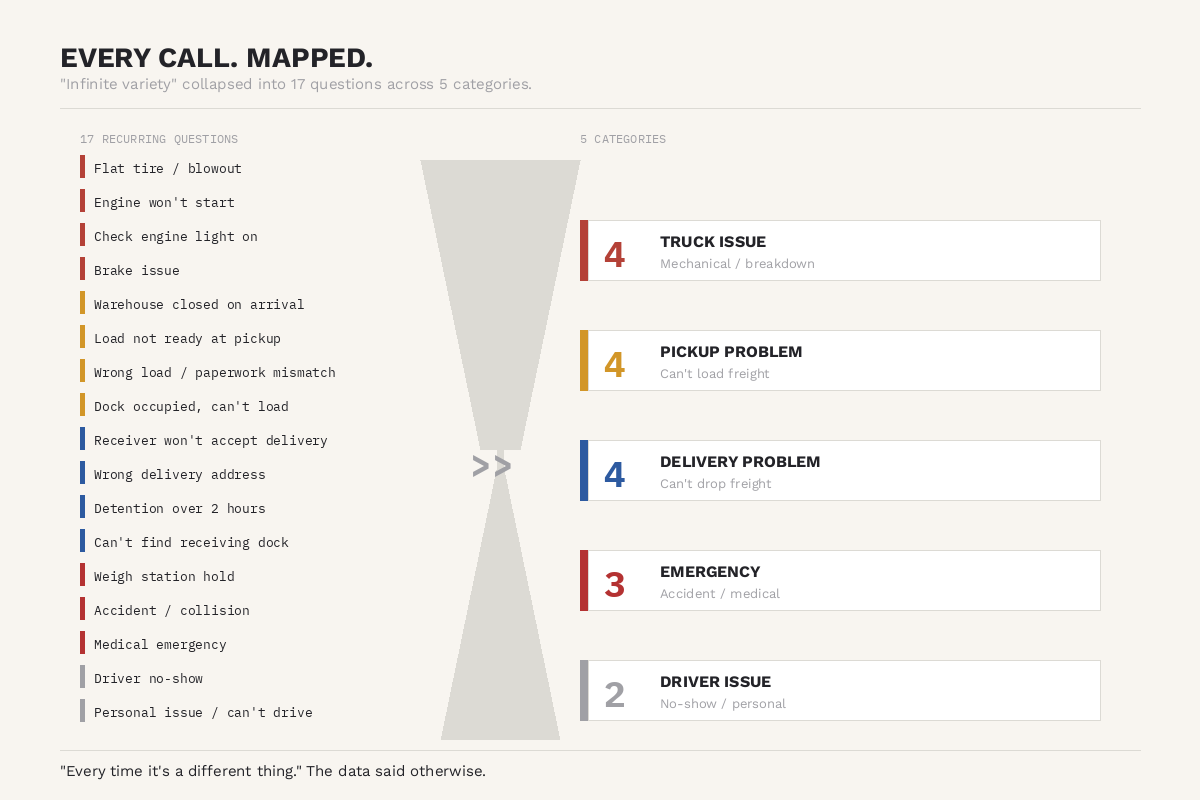
That was it. Every call.
What a Typical Day Looked Like
To understand why the call center didn't need to exist, you need to see what "handling a call" meant.
Here's a real scenario. A driver arrives at a warehouse for an 8am pickup. The warehouse is either closed or the people at the dock have no idea who he is, or what load he's supposed to pick up. Nobody knows anything.
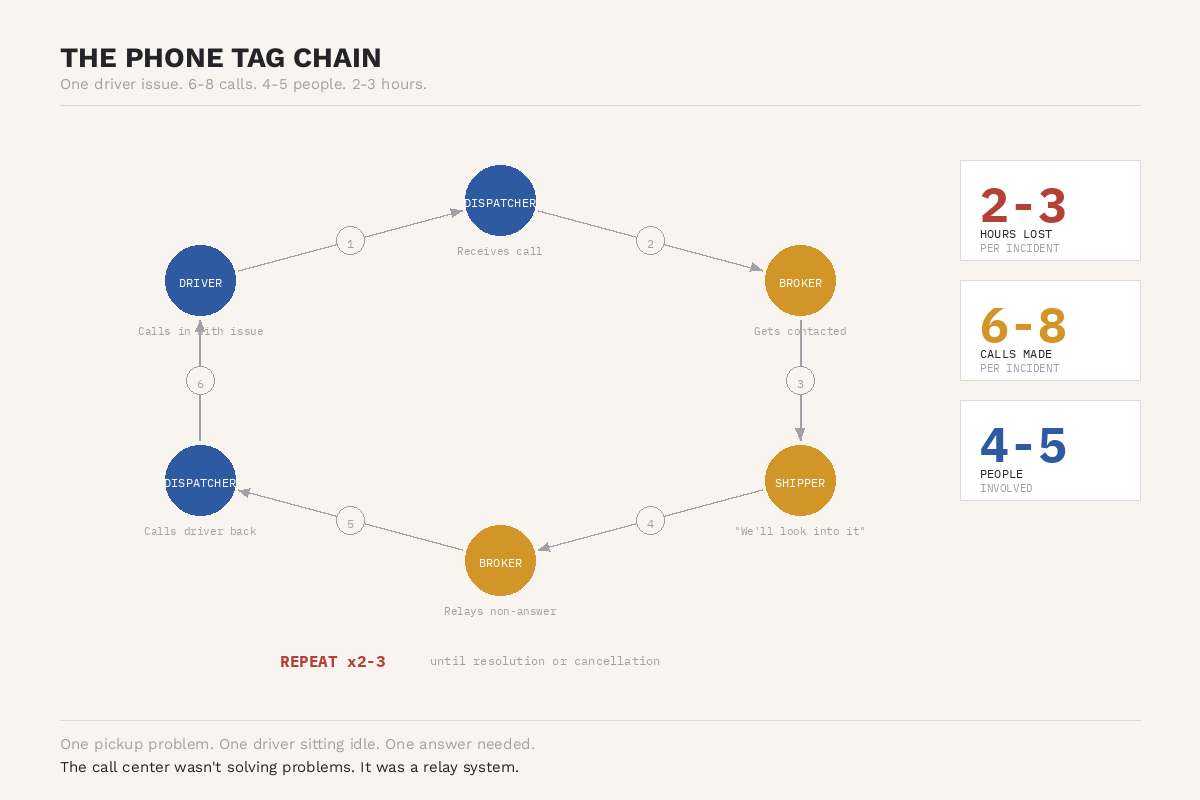
So the driver calls the dispatcher. The dispatcher calls the broker. The broker calls the shipper. The shipper says they'll figure it out. An hour passes. Nothing happens. The driver calls the dispatcher again. The chain repeats. Broker to customer to shipper. This goes around 2-3 times before either cancellation fee is paid or someone finally finds the freight and loads the truck.
That's one "call." Except it's not one call. It's 6-8 calls across 4-5 people over 2-3 hours. And a big chunk of that time is just trying to get past other businesses' AI to reach a real person. Breakdowns, weigh station stops, detention at warehouses - different problems, same phone tag chain. Every one of these looks unique when you're the person fielding calls. But read enough transcripts and the pattern is always the same.
The Phone Call Was the Problem
From the driver's perspective, none of that chain matters. He's sitting at a warehouse dock or on the shoulder of a highway. He'd rather tap a button, type three words about what's wrong, snap a photo, and relax until somebody texts him what to do next.
The call center wasn't solving the driver's problem. It was a relay system that existed because phone calls were the only channel anyone had.
What We Built Instead of a $20K Voice Agent
A mobile-friendly web app. Drivers open it, pick their problem category, add a short description or voice note, attach a photo if needed, and submit. That's the whole interface.
Behind the app, each category triggers a different workflow.
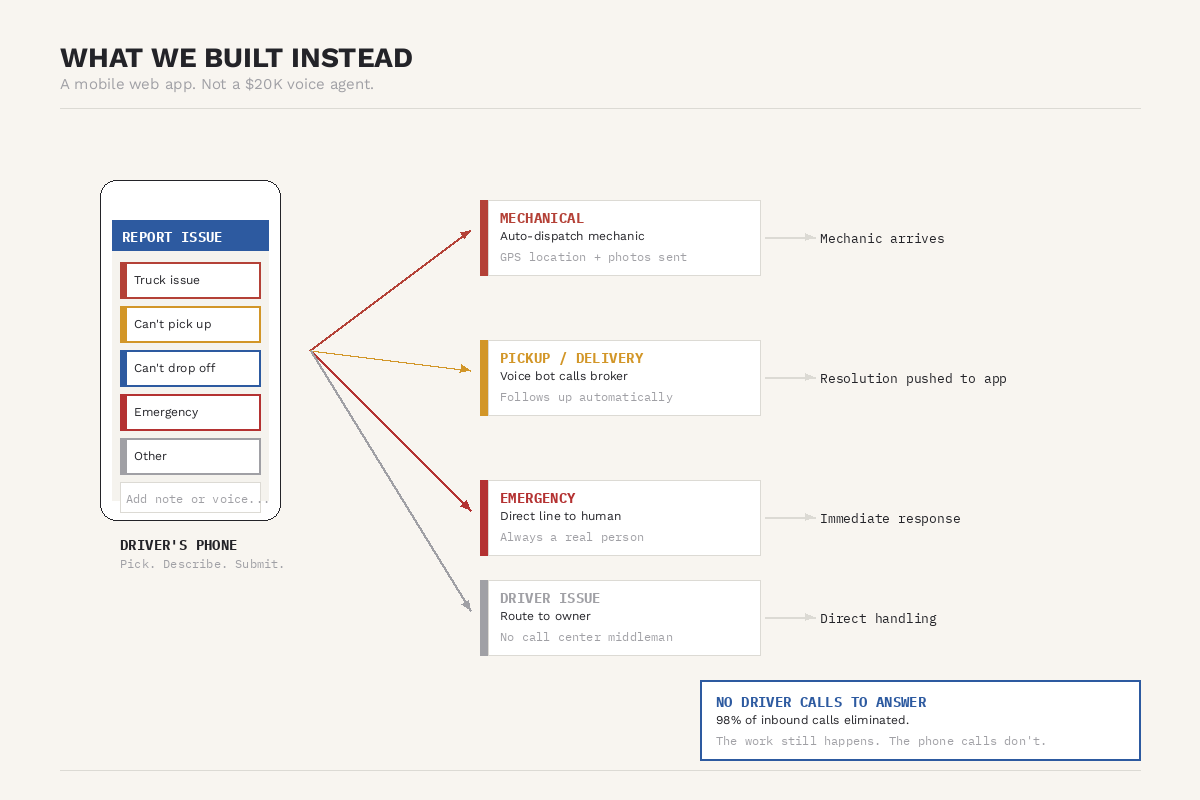
The pickup and delivery route is where the real value lives. This is where the phone tag chain used to eat hours. A dispatcher would call the broker, wait, call again, get a runaround, call again. Now a purpose-built voice bot handles that entire chain. It calls the broker, explains the situation - load number, pickup location, what the driver is seeing at the warehouse. If the broker says they'll look into it, the bot follows up. And follows up again. It will keep working the chain the same way a dispatcher would, except it doesn't get frustrated, doesn't forget, and doesn't have ten other things competing for its attention. Once it gets a resolution, it pushes the result back to the driver's app.
Compare that to the $20K voice agent the owner originally wanted. That bot would need access to every internal system, understand dozens of scenarios, and handle open-ended conversations. Our broker bot gets a load number, a pickup location, and a phone number. It calls one person about one load and reports the answer back. Token costs near zero. No access to internal systems. One job, done well.
The Numbers
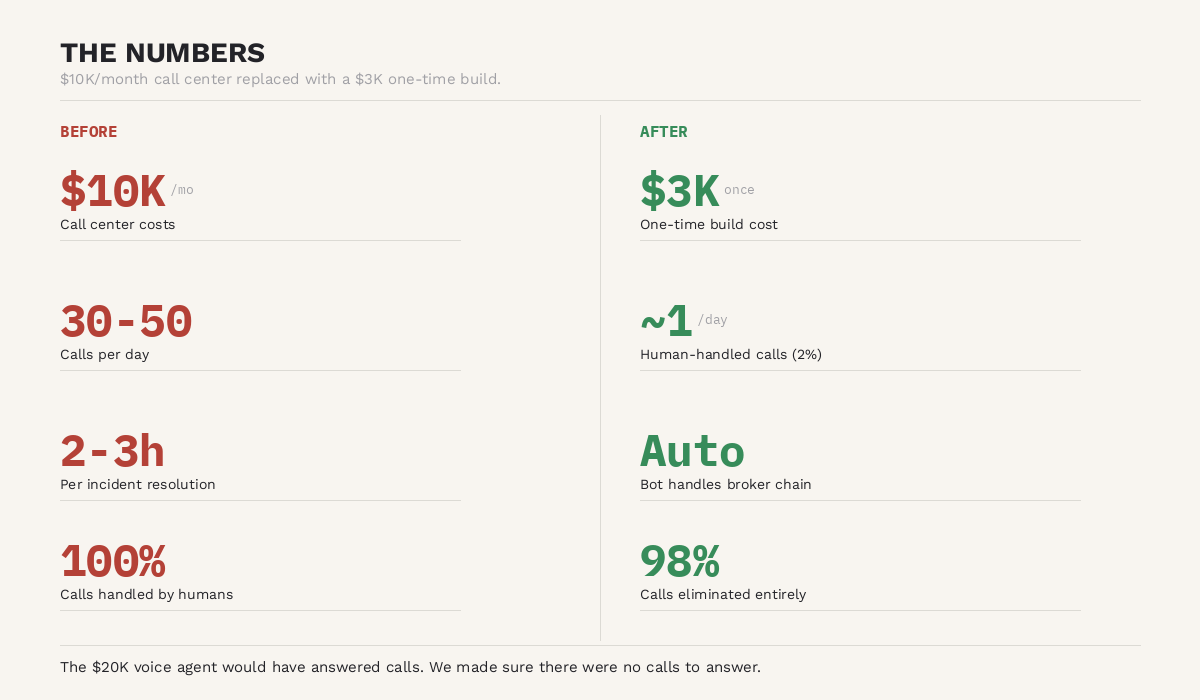
The work didn't disappear. Trucks still break down. Warehouses still lose track of loads. Brokers still need to be called. But drivers stopped calling in, and bots took over the phone tag that used to eat dispatcher hours. There were no driver calls left to answer.
The Real Lesson
The owner came to us ready to spend $20K on a voice agent. We could have taken that money. Instead we spent a few days reading call transcripts and asked: do these phone calls need to happen at all?
A web form and a couple of narrow bots cost $3K to build. They eliminated 98% of inbound calls and automated the outbound phone tag that ate dispatcher hours. The right tool wasn't the most impressive one. It was the one that matched the actual problem.
Spending money on things your business might not need?
We can help you figure out what actually moves the needle.
Talk to HatcherSoft